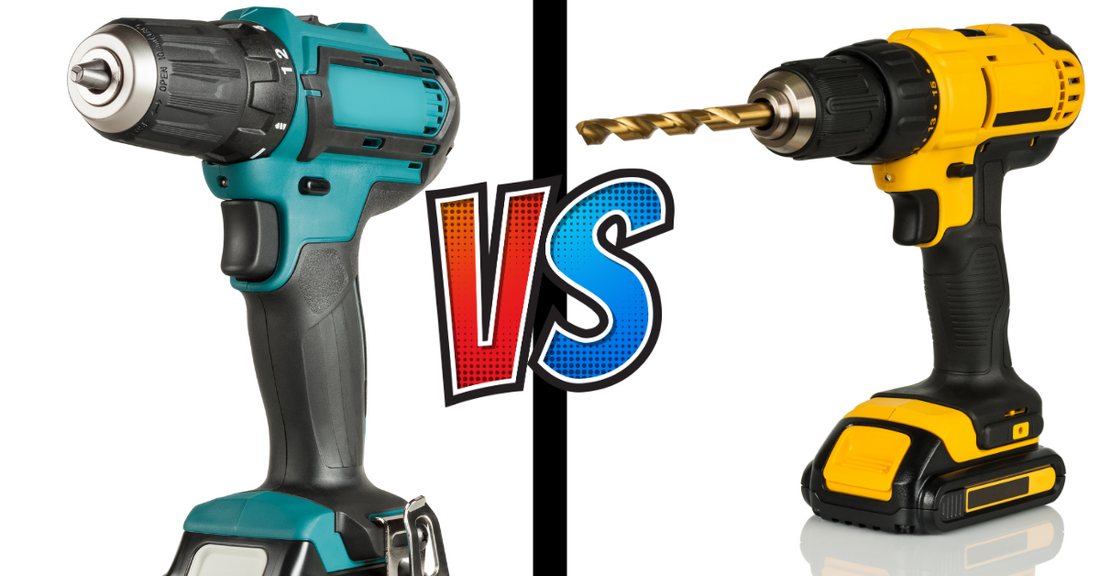
When you're building your first deck, putting up a fence, or framing a pergola, one question keeps coming up: do I need a drill, an impact driver, or both? After nearly 30 years of working with timber and deck screws, we've watched plenty of folks wrestle with this choice. We're here to walk you through it like a patient neighbor leaning over the fence, sharing what actually works.
This guide breaks it all down step by step, with clear visuals and real‑world cues, so you can pick the right tool, choose the best impact driver and drill for deck screws, drive screws confidently, and finish your project without stripped heads or sore wrists.
In this guide:
The Difference Between the Impact driver and Drill for Decking Screws
A drill spins smoothly at adjustable speeds, perfect for clean holes and gentle screw‑setting, while an impact driver kicks in with a rapid rat‑tat‑tat hammering action under load, muscling long screws home with way less twist on your wrist. Here’s the difference on impact driver vs. drill for deck screws.

|
Impact driver and drill difference |
Drill |
Impact Driver |
|
Best for |
Pilot holes, precise drilling, small screws, hardware |
Deck screws, lag bolts, structural fasteners |
|
Torque |
Lower (500–1,200 in-lbs typical) |
Higher (1,500–2,200+ in-lbs) |
|
Speed control |
Variable speed trigger + clutch settings |
Limited speed control, impact bursts |
|
Bit type |
Round or hex shank (⅜" or ½" chuck) |
Hex shank only (quick-release) |
|
Sound |
Smooth whir |
Loud rat-tat-tat chatter |
|
Wrist strain |
Can twist on long screws or stuck bits |
Minimal—tool absorbs rotational kick |
|
Materials |
Wood, metal, masonry (with hammer mode), tile/glass |
Wood framing, dense lumber, metal fasteners |
|
Typical use on deck |
Pre-drilling pilots, countersinks, hinges, brackets |
Driving 100+ deck screws, lag bolts, joists |
When to use an impact driver vs. drill for deck screws?
Use a drill when precision matters: pilot holes, countersinks, hardware installs, and anywhere you need controlled speed.
Use an impact driver when power and speed matter: driving dozens of deck screws, sinking lag bolts, or muscling structural fasteners through dense lumber.
But deck building isn't that simple. Knowing which fastening tool to grab depends on the exact task in front of you. Here's how to know when to use your impact driver and your drill based on what fastening you’re doing when constructing your deck:
When to use a drill on deck construction:

-
If you want clean, straight holes that land right on your pencil mark, reach for the drill. It feels steady in your hand, tracks true, and hums with a smooth, even whir.
-
If you're hanging gate hinges or small hardware, set the drill's clutch light. You'll feel gentle clicks as screws snug up, and the heads settle flush without a surprise shove.
-
If you're countersinking screw heads for plugs or a flush finish, use the drill with a countersink bit. The controlled speed and clutch prevent you from boring too deep, and you'll see the recess form evenly without splintering the deck board edges.
-
If you're drilling hardwood decking or metal brackets and the hole size matters, choose the drill. You'll feel a controlled push, see clean chips curling out, and hear a low RPM that keeps the bit cool.
-
If you're just starting out or aiming for a perfect finish, use your first. The smooth spin and clutch give you a safety net so there's no jolt that mars the surface.
-
If you're setting anchors in concrete footings, use a hammer drill mode (not an impact driver). You'll feel forward thumps doing the work, see dust streaming, and hear a deeper hammer tone.
-
If you're pre‑drilling pilot holes before driving deck screws, keep the drill chucked with a pilot bit. The steady whir makes pilots effortless and sets up clean, split‑free screw seating.
When to use an impact driver on deck construction:
-
If you're running dozens of deck screws or framing fasteners, use an impact driver. It stays locked in the screw head, your wrist stays relaxed, and you'll hear that rat‑tat‑tat as it powers through knots and dense pressure‑treated lumber.
-
If you're sinking long lag bolts into posts or structural screws into joists, use the impact driver. It feels compact and planted with minimal wrist twist, and the rhythmic tapping walks the fastener home without cam‑out.
-
If you're working overhead on a pergola beam or reaching into tight joist bays, pick the impact driver. It tucks into cramped spots, feels lighter on the forearm, and the short bursts mean less fighting awkward angles.
-
If a screw gets stuck in dense cedar or your bit keeps slipping, switch to the impact driver. The pulsing torque helps the bit bite, you feel less sudden twist in your wrist, and the chatter signals it's breaking the screw loose cleanly.
-
If you're running pilot‑then‑drive cycles all day, pair the impact driver with a driver bit while the drill stays on the pilot. You'll fall into a rhythm (smooth whir, then chatter) without stopping to swap bits every time.

Can you use an impact driver as a drill?
Yes, but with care and the right expectations. An impact driver can spin hex‑shank drill bits for rough holes in softer decking lumber, but it lacks the smooth, variable speed control a drill offers for precise, clean bores.
Will this damage your work or tools? Using an impact driver to drill big holes or bore into hardwoods without impact‑rated bits can leave ragged edges, egg‑shaped holes, or shatter regular bits. Save your impact driver for driving screws, and reach for the drill when hole quality matters (like when you're routing cables or setting decorative plugs).
Can a drill bit go in an impact driver?
Impact drivers accept hex‑shank bits, which means standard round‑shank twist drills won't fit unless they come with a hex adapter. Even when they do fit, impact‑rated drill bits handle the hammering torque without snapping or rounding over.
Which bits should you buy? Stock up on impact‑rated hex‑shank drill bits. The best deck screws have Torx driver bits, so stock up on those, too. Torx bits resist wear, grip screw heads tightly, and survive the chatter of daily deck work without stripping out.
Do you need a drill if you have an impact?
Yes, you need them both when building a deck. The impact driver powers through driving screws fast, but the drill is what handles precise pilot holes, countersinks, and all those smaller drilling tasks where finesse matters. Most pros and serious DIYers keep both within arm's reach.
What has more power, a drill or impact driver?
Impact drivers deliver far more torque. Their internal hammering mechanism puts power exactly where you need it when you're driving long screws into dense framing lumber.
Drills take a different approach: they give you variable speed and fine control for delicate drilling and precision fastening work where you don't want to overdo it.
Will more torque always mean better results? Not necessarily. Too much torque can split cedar rails, overdrive composite deck screws below the surface, or strip screw heads if you're not paying attention. Matching tool, bit, and screw to your project (and your wood species) keeps power productive, not destructive.
What's the most common rookie mistake with the drill and impact driver?
Many first‑timers grab whatever bit or screw is handy without considering the wood species, fastener length, or the tool's capacity. This leads to split deck boards, stripped screw heads, or slow, frustrating work that saps the fun from building.
What should you watch for? Notice if screws aren't seating flush, if the bit tip walks off the fastener, or if you hear a grinding sound instead of a confident chatter.
These clues tell you the bit doesn't match the screw's recess, or you need to pre‑drill with the right pilot size for your specific wood. Cedar, pressure‑treated pine, hardwood, or composites all have different densities and splitting thresholds.
Best Impact Driver For Building A Deck
When you're staring down dozens of joists and hundreds of deck screws, the right impact driver makes the difference between a smooth workday and a sore wrist by lunchtime.
After building hundreds of decks over the years, we've put a lot of different impact drivers through their paces. We've sunk lag bolts into ledger boards, driven structural screws into joists, and run them through the kind of work you'll actually face on a real deck build.
These are the best brands of impact drivers that keep rising to the top for speed, power, and the kind of all-day comfort that saves your wrist when you're 200 screws deep.
1. DeWalt DCF860: Best impact driver for deck building
The DeWalt DCF860 is the best impact driver for building a deck when your project involves lots of ledger boards, posts, and heavy structural fasteners:
-
Sank 5‑inch lag bolts in an average of 4.95 seconds (nearly a second faster than the competition)
-
Delivered 1,886 inch‑pounds of measured torque—real-world proven for deck framing
-
Drove deck screws at 1.41 seconds each with barely a stumble
What you'll notice right away is the aggressive rat‑tat‑tat that hits hard without the wild wrist twist. It runs at 96 dB under load, louder than some, but the speed and control make up for it and that’s why the DeWalt DCF860 is the best impact driver for deck screws.
Best for: Professional deck builders who frame and deck regularly and need that extra punch to muscle through knots, dense pressure‑treated lumber, and heavy lag bolts for ledger boards.

2. Milwaukee M18 Fuel Gen 4: Best Milwaukee impact driver
The Milwaukee M18 Fuel (model 2953‑20) is the go-to when you're running hundreds of deck screws day after day:
-
Maxed out at 2,217 inch‑pounds of torque—the highest measured in the test
-
Averaged 5.86 seconds on lag bolts and 1.63 seconds on deck screws
-
Feels compact at just 4.5 inches long
-
Tracks smoothly at low speeds (around 77 RPM without stalling)
-
Runs at 98.9 dB, slightly quieter than the DeWalt
The Milwaukee's trigger control is exceptionally smooth, so you can feather screws to flush without overdrive.
The pulsing impact feels steady and controlled in your hand and not rattling your wrist or trying to twist away from you. That makes a big difference when you're working overhead reaching into joist bays all day, where every bit of control and comfort counts.
Best for: Pros who value both power and ergonomics for large decks or commercial decking projects. Speed (measured in seconds per screw) and vibration control matter more than peak torque when you're driving 200+ fasteners, and the Milwaukee handles both exceptionally well, especially when paired with a collated feed system.
3. Hercules: Best budget impact driver for weekend deck builders
For best value without sacrificing speed, the Hercules delivers 90% of the performance at 50% of the cost:
-
Averaged 6.27 seconds on lag bolts
-
Hit 1,882 inch‑pounds of torque—nearly matching the DeWalt's output at half the price
-
Spins the fastest of any driver tested at 3,655 RPM, breezing through softer decking lumber
It does vibrate a bit more noticeably than the Milwaukee. At 3.73 pounds with a 5 amp‑hour battery, it's not the lightest, but the balance feels solid and the chatter stays manageable for day‑long framing sessions.
Best for: Weekend warriors building one or two decks a year who want serious torque without the pro‑grade price tag. If you're tackling one deck at a time, Hercules is the best impact driver for the money.
4. DeWalt DCF870: Best hydraulic impact driver for a quiet operation
If you're working in occupied spaces, like deck additions near bedrooms or projects where neighbors are close, the DeWalt DCF870 is the best hydraulic impact driver for a quiet operation:
-
Measures just 91.1 dB under load (about 5 dB quieter than standard drivers)
-
Feels smoother in the hand with far less vibration
-
Still drove deck screws in 1.53 seconds on average
The trade‑off is lower torque at 654 inch‑pounds, which makes it less ideal for heavy lag bolts or structural screws but perfectly suited for finish deck work, railing hardware, and anywhere you want to avoid disturbing folks nearby.
Best for: Builders who value comfort and not rattling the windows next door as much as raw speed.
PRO TIPS on Using an Impact Driver for Building a Deck
-
We pair our impact driver with the Simpson Strong-Tie Quik Drive Pro and Timber Drive Pro for large decks or commercial deck building projects. Screw guns help us “yes” to more deck building projects, since we get the job done right and fast.
-
Stick with 4 amp‑hour minimum for deck work since driving long structural screws might reduce run time. Also, keep a spare charger so you're not waiting mid‑joist.
Best Drill For Deck Building
While the impact driver handles the heavy lifting of driving screws, a good drill is just as essential for pilot holes, countersinks, hardware installs, and the hundred small tasks that come up during a deck build.
1. Milwaukee M18 Fuel (2804-20): Best for pros and frequent builders
-
Brushless motor for longer runtime and less heat
-
Two-speed gearbox: 0-550 RPM (low) and 0-1,800 RPM (high)
-
½-inch metal chuck grips bits securely even with side load
-
15+1 clutch settings for precise hardware installs
-
Compact at 7.5 inches long, fits tight joist bays
The M18 Fuel line delivers M12 size and weight with serious power. It’s perfect if you're moving between pilot holes and driving tasks without swapping tools constantly.
2. DeWalt DCD771 (20V Max): Best balance of price and performance
-
Two-speed transmission: 0-450 / 0-1,500 RPM
-
½-inch single-sleeve chuck for fast bit changes
-
16-position clutch plus drill mode
-
Lightweight at 3.6 pounds with a compact battery
DeWalt's 20V platform is widely available, and combo kits (drill + impact driver + two batteries + charger.
3. Makita XFD131 (18V LXT): Best for longevity and runtime
-
Brushless motor with efficient power delivery
-
Two-speed gearbox: 0-600 / 0-1,900 RPM
-
½-inch chuck with all-metal construction
-
21-position clutch for fine-tuned control
Makita will last the longest. It's a solid middle ground for builders who want reliability without the premium price.
4. Ryobi HP (18V One+): Best value for occasional builders
-
Brushless HP motor (higher performance than standard Ryobi)
-
Two-speed: 0-550 / 0-1,800 RPM
-
½-inch chuck
-
24-position clutch for detailed work
We've heard of builders having issues with Ryobi HP failing during intensive deck rebuilds, but for one or two deck projects and light remodeling, this budget drill is best. Just keep expectations realistic if you're planning to use it day in, day out like a pro. It's built for weekend projects, not job-site marathons.
PRO TIPS on What to look for in a drill for deck building
-
Look for 15+ clutch settings. When installing hinges, brackets, and railing hardware, an impact driver's power can strip small screws or crack trim. A drill with 15+ clutch settings lets you dial in the exact torque so screws stop right at flush—no overdrive, no damage.
-
Two-speed gearbox makes all the difference. Pressure-treated pine, cedar, composite, and hardwood all drill differently. A two-speed gearbox (low for torque, high for speed) plus a sensitive trigger lets you adjust on the fly as you move from soft deck boards to dense joist lumber.
-
Go with a ½-inch chuck, not ⅜-inch. Beyond basic pilot holes, deck projects often call for larger bits: spade bits for routing cables through joists, hole saws for post-light installs, and step bits for metal brackets. A ½-inch chuck handles these without adapters, while ⅜-inch chucks limit you to smaller bits and force you to hunt for workarounds.
-
Match your drill battery to your impact driver. Buy within the same battery platform as your impact driver. If you went with Milwaukee M18 for the driver, grab the Milwaukee M18 drill so batteries swap between tools all day. This way, there’s no downtime, no extra chargers cluttering your workspace.
The Fastening Tool Combo That's Worked For 30 Years (And Hundreds Of Decks)
After three decades and hundreds of deck builds, from backyard DIY projects to commercial jobs, we've learned one truth: the right impact driver and drill pairing saves more than time. It saves your body and your reputation.
We've watched first-timers struggle with the wrong setup, stripped screws littering the deck boards, and sore wrists by midday. We've also helped contractors scale their businesses by showing them exactly which tools and screws hold up when deadlines are tight, lumber is dense, and clients are watching.
At ATC Construction Fasteners, we don't just sell fastening tools. We use them, test them, and stand behind them.
Not sure which setup fits your deck project? Ask our team of seasoned deck builders. We'll walk you through which impact driver, drill, screw guns, driver bits, and deck screws match your specific build, whether you're working with pressure-treated pine, composite, or hardwood decking. No sales pitch, just straight advice from builders who've done the work.


